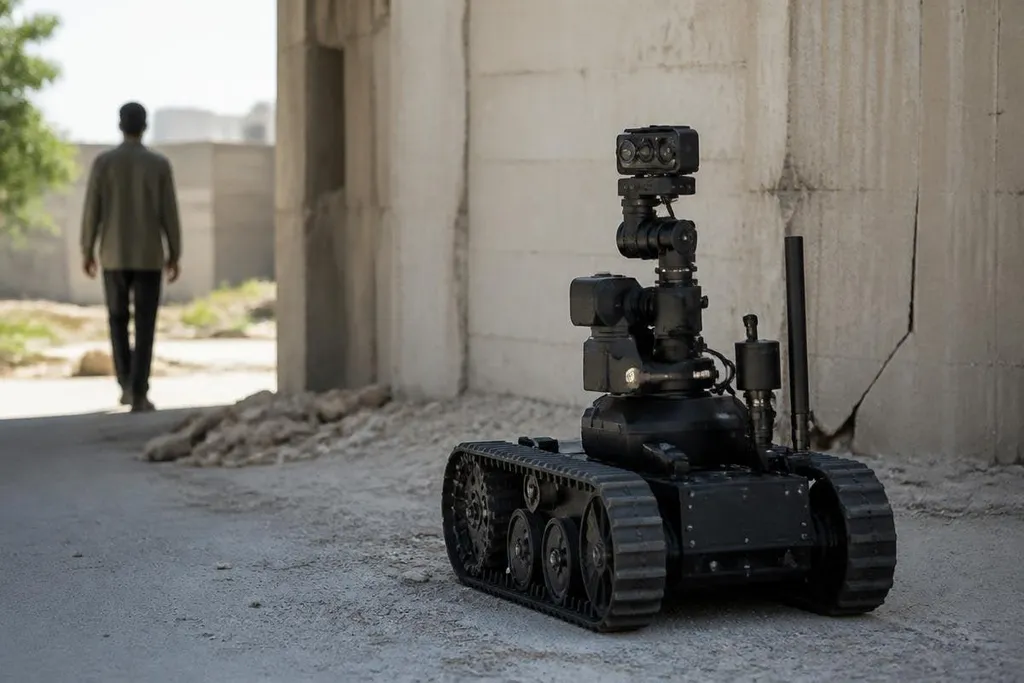
A military robot can spot a person, track movement, carry weapons, or choose where to move without a soldier standing beside it. The ethical risk starts when software makes a decision that people cannot explain, review, or stop in time.
- Autonomous target selection can shift life-and-death judgment from a person to software.
- Remote operators may act on incomplete sensor data and delayed video.
- Clear records, human control, and testing must exist before deployment.
The decision problem
A robot may combine cameras, thermal sensors, mapping data, and software that sorts objects or people by set rules. That process can help a unit react faster, but speed does not prove that the decision is correct.
A sensor can mistake a civilian vehicle for a military one. Smoke, darkness, damaged equipment, or a crowded street can also change what the robot sees. The person who wrote the software may be far from the place where the decision happens, while the operator may have only seconds to act.
That creates a basic question: who carries responsibility when the robot causes harm? The operator may blame the software. The manufacturer may point to the operator. A commander may say the system passed a test. Without a clear chain of responsibility, the people affected may have no useful answer.
Human control is more than a stop button
A remote operator can review sensor feeds and approve an action. That sounds like human control, but the quality of that control depends on time, information, training, and the design of the interface.
A small video window may hide people outside the camera view. A delayed feed may show an earlier position. An alert system may present several warnings at once. In each case, the operator remains present in the process while lacking the information needed for a sound decision.
A physical stop button still matters. It cannot fix poor identification, weak communications, or unclear rules for use. Human control must cover the full decision: choosing the mission, setting limits, checking the robot's output, and stopping the action when the situation changes.
Bias can enter a target-recognition system through its training data before an operator sees its output. A dated Robot24 report can tie that claim to the machine, test setting, and recorded failure cases before the next section examines how those tests shape the record.
Bias, testing, and the record
Software learns from data and rules selected by people. If the data misses certain clothing, body shapes, vehicles, lighting conditions, or locations, the robot may perform worse in those cases. A test in a clear training area cannot answer how the system behaves in a damaged city or a crowded border crossing.
Testing should cover the conditions that can change a decision. It should also record failures, near misses, software changes, sensor limits, and the person who approved each release. An audit log gives investigators a path through the event instead of leaving them with a final result and no explanation.
The record matters after deployment too. A military force should know when the robot received an update, which map it used, what the operator saw, and why the system stopped or continued. If those details disappear, later review becomes guesswork.
Rules for a safer decision
The ethical case for a military robot is stronger when its limits are written before purchase. A review team should check these points:
- Mission limits: define where the robot may operate and which tasks remain under direct human control.
- Target rules: state what data can support an action and what uncertainty requires a pause.
- Operator view: test delays, blocked cameras, warning overload, and loss of communication.
- Failure response: set the robot's behavior after a sensor fault, software error, or map mismatch.
- Audit record: store commands, sensor status, software version, approvals, and stop events.
- Review power: give an independent team access to logs, test results, and incident reports.
These checks do not remove the moral problem. They make the choices visible, assign responsibility, and give people a way to stop a system that behaves outside its limits.
What should happen next
I would not approve a weapon system that cannot explain its limits and show a reliable human stop process.
The next decision should rest on test records, operator time, sensor failure rates, and a named person responsible for each use. Until those details are available, deployment is a political choice made in software, with other people carrying the cost.